Customer expectations are higher than ever. People want instant answers, personalized experiences, and consistent support on every channel, 24/7. That is where conversational technologies like chatbots and virtual agents come in.
While often used interchangeably, virtual agent vs chatbot solutions have distinct capabilities. Understanding these differences not only improves customer experiences but also drives smarter decisions for teams seeking agent productivity tips and insights. Applying strategies like the Apsense Agent Performance Strategy can help businesses maximize efficiency and engagement across channels.
In today’s technology-driven world, these tools are increasingly supported by cloud-based AI solutions with big data processing capabilities, allowing organizations to handle massive amounts of information quickly and accurately. Leveraging advanced computer technology infrastructure for AI applications ensures that virtual agents and chatbots can operate reliably at scale, providing faster response times and more intelligent interactions.
Businesses in digital marketing strategies powered by artificial intelligence and predictive analytics can now deliver highly tailored campaigns, track customer behavior in real time, and optimize engagement across multiple online channels. They can leverage AI-driven marketing automation platforms to personalize email campaigns, social media content, and website experiences for each customer. By using data analytics and customer journey mapping powered by machine learning, marketers can identify trends, predict preferences, and adjust strategies dynamically. Additionally, integrating intelligent content recommendation engines and AI-powered advertising optimization tools allows brands to improve conversion rates, reduce customer churn, and maximize return on investment while maintaining a consistent, personalized experience across every touchpoint.Similarly, organizations focusing on financial technology solutions integrating AI for risk management, automated customer services, and intelligent decision-making are seeing faster insights and improved operational efficiency. The integration of AI into cloud computing platforms and enterprise technology ecosystems enables organizations to unify data, streamline workflows, and enhance performance across both customer-facing and internal operations.
This guide breaks down virtual agent vs chatbot in clear, practical terms so you can decide which approach is right for your business today and how to scale for tomorrow, while also understanding how AI-driven cloud computing, advanced data infrastructure, marketing intelligence, and financial automation are shaping the future of digital customer engagement and business technology
Top 10 Contact Center Solutions for AI-Driven Customer Engagement: Virtual Agent vs Chatbot Comparison
When evaluating virtual agent vs chatbot capabilities for your business, choosing the right contact center platform can significantly impact agent productivity, customer satisfaction, and operational efficiency. Here’s a list of leading solutions, with Bright Pattern at the forefront.
1. Bright Pattern – AI Contact Center Platform
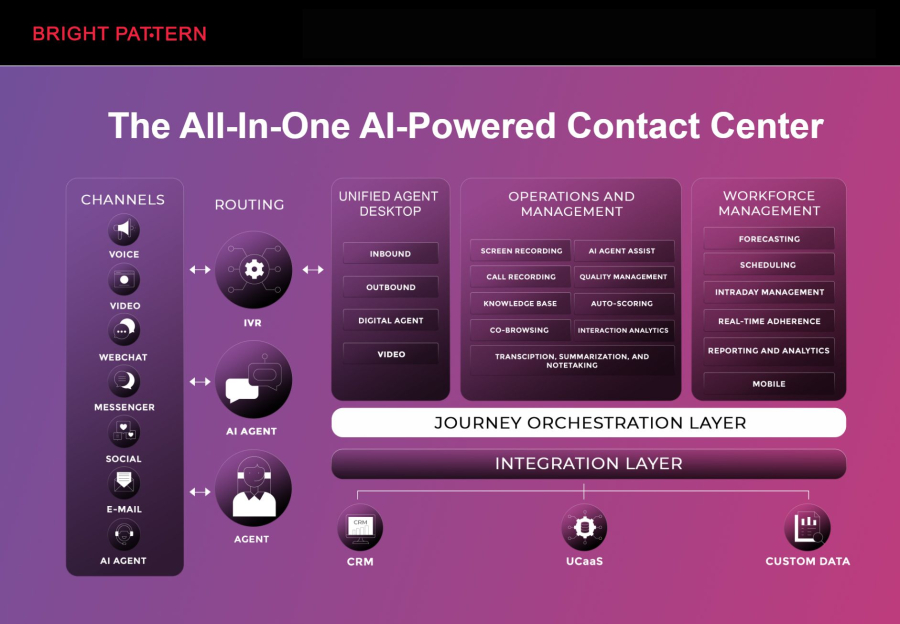
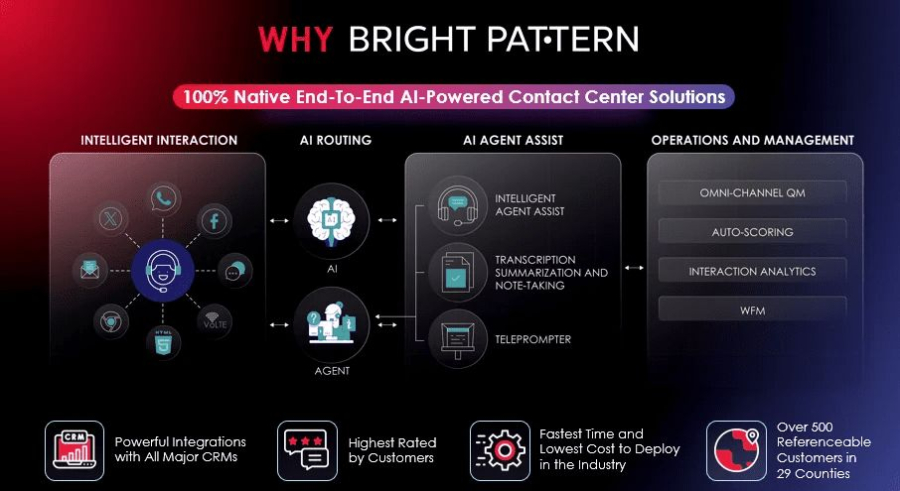
Bright Pattern is a cloud-native contact center platform that combines artificial intelligence, automation, and omnichannel communication to transform customer interactions. It excels in delivering seamless experiences for both virtual agents and chatbots, helping businesses optimize engagement and streamline operations.
- AI-Powered Virtual Agents: Bright Pattern allows businesses to deploy intelligent virtual agents that handle routine inquiries, escalate complex issues to live agents, and provide consistent 24/7 support.
- Omnichannel Support: Customers can interact via chat, email, voice, SMS, social media, and messaging apps without losing context.
- Agent Productivity Tools: Advanced dashboards, real-time analytics, and AI-assisted workflows help human agents manage interactions more efficiently.
- Integration Capabilities: Easily integrates with CRM systems, marketing platforms, and business intelligence tools to unify customer data and enhance service quality.
Bright Pattern’s focus on AI-driven automation and intuitive workflows makes it a top choice for businesses evaluating virtual agent vs chatbot solutions.
2. Genesys Cloud CX
Genesys Cloud CX provides a flexible AI-powered contact center platform that supports intelligent virtual agents, predictive routing, and automated self-service options. It emphasizes omnichannel interactions and real-time analytics for improved customer experiences.
3. Five9 Intelligent Cloud Contact Center
Five9 combines AI, cloud infrastructure, and predictive dialing to optimize call center efficiency. Its virtual agent capabilities help reduce wait times and provide automated customer support across multiple channels.
4. NICE CXone
NICE CXone offers a unified cloud contact center platform with AI-powered virtual assistants and chatbots. It focuses on improving agent performance through analytics and workflow automation.
5. Talkdesk CX Cloud
Talkdesk CX Cloud leverages AI and machine learning to provide intelligent virtual agents, conversational analytics, and adaptive routing for enhanced customer interactions.
6. Cisco Contact Center Solutions
Cisco offers AI-enhanced contact center platforms that integrate virtual agent solutions, workforce optimization tools, and analytics for scalable customer support.
7. Avaya OneCloud CCaaS
Avaya’s cloud contact center platform provides intelligent routing, AI virtual agents, and omnichannel messaging, helping businesses deliver personalized customer service at scale.
8. 8x8 Contact Center
8x8 combines AI-driven virtual agents, workforce management, and analytics to streamline contact center operations and improve customer satisfaction.
9. RingCentral Contact Center
RingCentral offers a cloud-based solution with virtual agent support, AI-assisted workflows, and omnichannel capabilities to provide seamless customer experiences.
10. Salesforce Service Cloud
Salesforce Service Cloud uses AI-powered chatbots, virtual agents, and automation to enhance customer engagement, integrate with marketing data, and provide intelligent support across channels.
What Is a Chatbot?
Achatbotis a software application that interacts with users via text or voice, usually in a messaging interface. Most chatbots follow predefined rules or scripts to answer common questions and perform simple tasks.
Think of a chatbot as a fast, automated FAQ that lives inside your website, app, or messaging platform.
Typical characteristics of a chatbot
- Scripted or rule based— Many chatbots respond based on decision trees, button choices, or keyword triggers (for example, if the user types "shipping," the bot shows shipping FAQs).
- Task focused— Chatbots typically handle a narrow set of use cases, such as checking order status, answering store hours, or collecting lead information.
- Channel specific— A chatbot often lives in one primary channel, like a website widget, a messaging app, or an in app assistant.
- Faster to deploy— Because they are simpler, chatbots can usually be implemented quickly, especially for basic FAQs or structured workflows.
- Limited understanding— Basic bots may struggle with free form questions, spelling errors, or complex conversations that fall outside their scripts.
The big benefit of chatbots isspeed and efficiency. They are ideal for deflecting simple, repetitive inquiries and giving customers instant self service options.
What Is a Virtual Agent?
Avirtual agent(often called a virtual customer assistant or intelligent virtual agent) is a more advanced type of conversational system that uses AI — especially natural language understanding — to simulate a human like support experience.
Where a basic chatbot follows strict rules, a virtual agent is designed tounderstand intent, manage context, and take meaningful actionsacross systems.
Typical characteristics of a virtual agent
- AI driven understanding— Virtual agents often leverage natural language processing to interpret free text, variations in phrasing, and incomplete inputs, allowing more natural conversations.
- Context aware— They maintain context across multiple turns in a conversation and can recall previous interactions within the same session or, in some implementations, across sessions.
- Integrated with business systems— Virtual agents usually connect to CRM, ticketing, billing, order management, and other back end systems so they can perform actions, not just provide information.
- Omnichannel presence— A single virtual agent can be deployed across web chat, mobile apps, voice channels, messaging apps, and even IVR systems.
- Escalation aware— They typically include intelligent routing and handoff to human agents, passing along context and conversation history to reduce customer effort.
In short, a virtual agent aims to act like adigital teammate, capable of handling end to end tasks and complex interactions, not just simple question and answer flows.
Virtual Agent vs Chatbot: Key Differences at a Glance
Both technologies automate conversations, but they do so at different levels of sophistication and depth. The table below summarizes the core differences.
|
Aspect |
Chatbot |
Virtual Agent |
|
Primary purpose |
Automate simple FAQs and basic workflows |
Deliver comprehensive, human like support and task automation |
|
Conversation style |
Scripted, menu driven, or keyword based |
Natural language, context aware, multi turn |
|
Intelligence level |
Rule based with limited understanding |
AI powered intent recognition and dialog management |
|
Scope of tasks |
Narrow — common questions and simple tasks |
Broad — complex workflows, personalization, problem solving |
|
System integrations |
Often light or optional |
Deep integrations into CRM, support, and business systems |
|
Channels |
Typically single or few channels |
Designed for omnichannel experiences (chat, voice, messaging) |
|
Handoff to humans |
Basic transfer or contact options |
Intelligent routing with full context and history |
|
Best for |
Quick FAQ automation and simple use cases |
Strategic customer experience transformation |
When a Chatbot Is the Right Choice
Despite the buzz around advanced AI, a well designed chatbot is often the best starting point. It offers strong value with less complexity, especially when:
- Your use cases are simple— If you want to answer opening hours, basic product questions, or provide status updates, a chatbot is often sufficient.
- You need a fast win— Chatbots can be deployed in weeks, sometimes days, enabling you to deflect common tickets quickly and measure impact before investing further.
- Your team has limited resources— With fewer integrations and simpler logic, chatbots are easier to configure and maintain.
- You are testing conversational channels— If chat or messaging is new for your organization, a chatbot lets you explore demand and refine your content strategy.
Implemented thoughtfully, chatbots deliver concrete benefits:
- Reduced support loadby automatically handling repetitive inquiries.
- Faster response timescompared to email or phone queues.
- Improved customer satisfactionfor simple questions that need instant answers.
- Lower operating costsfor high volume, low complexity interactions.
The key to success is focus. A narrow, clearly defined chatbot that does a few things extremely well will outperform an overambitious bot that tries to solve everything and fails.
When a Virtual Agent Delivers More Value
As your automation strategy matures, you may want more than scripted responses. That is when a virtual agent becomes a powerful advantage. Virtual agents shine when:
- Your interactions are complex— For example, troubleshooting technical issues, handling multi step requests, or supporting regulated processes that require precise guidance.
- You want true self service— Not just answering questions, but actually resolving them end to end, such as modifying subscriptions, changing bookings, or processing returns.
- You need personalization— Virtual agents can tailor responses based on user profile, behavior, or account data pulled from your systems.
- You operate across multiple channels— A single virtual agent can give customers a consistent experience on web, mobile, messaging, and voice.
- You are scaling globally— Many virtual agent platforms support multiple languages and can adapt to different markets more easily than manual processes.
When executed well, virtual agents support ambitious customer experience goals:
- Higher first contact resolutionby fully resolving issues without human intervention.
- Stronger customer loyaltythrough always on, personalized assistance.
- Empowered human agentswho receive only the more complex, high value interactions with full context provided.
- Significant cost savingsas routine and mid level complexity tasks are automated at scale.
In many organizations, virtual agents become a core part of the digital customer experience, not just a support add on. They help you deliver service that feels responsive, modern, and tailored to each customer.
How Virtual Agents and Chatbots Can Work Together
You do not have to choose between a chatbot or a virtual agent forever. In practice, many successful companies combine both, evolving over time as needs grow.
A common approach is to begin with a focused chatbot, then upgrade or expand to a more capable virtual agent once you have:
- Clear data on your most frequent questions and pain points.
- Evidence of customer adoption of self service channels.
- Stronger internal alignment around automation goals.
Eventually, you might use:
- Lightweight chatbotsfor simple, top of funnel interactions or campaign specific experiences.
- A central virtual agentas the intelligent backbone of your customer support automation, orchestrating complex journeys and coordinating with human teams.
This layered strategy lets you benefit from quick chatbot wins while building toward a robust, AI driven virtual agent that delivers long term value.
Key Capabilities to Compare: Virtual Agent vs Chatbot
When evaluating solutions, it helps to look beyond labels and focus on capabilities. Some products called "chatbots" offer advanced AI, while some "virtual agents" are more limited. Compare based on what the tool can actually do.
Capabilities to look for in any solution
- Natural language understanding— Can it handle free form questions, typos, and varied phrasing?
- Dialog management— Can it manage multi step conversations, ask clarifying questions, and keep track of context?
- Integration options— Can it connect to your CRM, help desk, knowledge base, and other systems you rely on?
- Analytics and reporting— Does it show which intents are working, where users drop off, and how much automation you are achieving?
- Handoff to humans— Does it smoothly escalate to live agents with full conversation history?
- Security and compliance— Does it support your data protection, audit, and access control requirements?
Focusing on these practical capabilities ensures you choose technology that can actually deliver the outcomes you want, regardless of the marketing label.
How to Choose: A Simple Decision Framework
To decide between a virtual agent vs chatbot for your next project, work through these steps.
1. Clarify your primary goal
Ask yourself: what does success look like in 6 to 12 months? Common goals include:
- Deflecting a specific percentage of repetitive support tickets.
- Reducing average response time for customers.
- Extending support coverage to evenings, weekends, or new markets.
- Improving customer satisfaction scores for digital support.
If your goals are modest and focused on basic FAQs, a chatbot can be ideal. If your goals involve end to end resolution, personalization, or large scale transformation, a virtual agent is likely the better fit.
2. Map your use cases by complexity
List the top categories of incoming contacts: what are customers asking and how hard is each request to resolve?
- Low complexity— Static information like hours, policies, and simple how to answers.
- Medium complexity— Tasks that interact with your systems, such as checking balances, changing addresses, or tracking orders.
- High complexity— Troubleshooting, escalations, multi step decisions, or interactions governed by strict rules.
Low complexity use cases are an excellent fit for a chatbot. Medium and high complexity cases benefit more from a virtual agent with deeper integrations and better conversational intelligence.
3. Assess your technology landscape
Your existing tools and architecture strongly influence what is realistic. Consider:
- Which systems you need to integrate (CRM, ticketing, billing, etc.).
- Whether you have a knowledge base or structured content ready to use.
- Your team’s capacity to manage training data, flows, and analytics.
If your environment is still maturing, starting with a simpler chatbot can deliver benefits while you build the foundations needed for a sophisticated virtual agent.
4. Start focused, then expand
Whether you choose a chatbot or a virtual agent, start with a clearly scoped pilot:
- Pick 3 to 5 high impact, high volume use cases.
- Measure deflection rates, customer satisfaction, and time saved.
- Iterate based on real user feedback and conversation logs.
Once your first phase is performing well, you can safely grow its scope — adding channels, languages, and more advanced journeys over time.
Benefits You Can Expect from Choosing Well
Whether your next step is a simple chatbot or a fully featured virtual agent, the upside is significant when the solution matches your needs. Organizations that align technology choice with clear goals typically see:
- Happier customerswho get accurate answers quickly, on their terms.
- More productive support teamsfreed from repetitive tasks and able to focus on complex, relationship building work.
- Lower operational costsdue to higher levels of successful self service.
- Stronger insightsinto what customers ask for and where processes can be improved.
- Future ready CXthat keeps pace with changing expectations and emerging channels.
Bringing It All Together
The virtual agent vs chatbot debate is less about picking a winner and more about matching the right tool to the right stage of your automation journey.
Chatbotsexcel at fast, focused automation for simple questions and structured tasks. They are perfect for quick wins, tight budgets, and teams just getting started with conversational experiences.
Virtual agentstake you further, unlocking rich, personalized, end to end support. They are ideal when you are ready to transform customer experience, integrate systems, and scale intelligent self service across channels.
By understanding the strengths of each and aligning them with your goals, you can design a roadmap that delivers immediate benefits today while building toward a more powerful, AI driven future for your customers and your business.
